
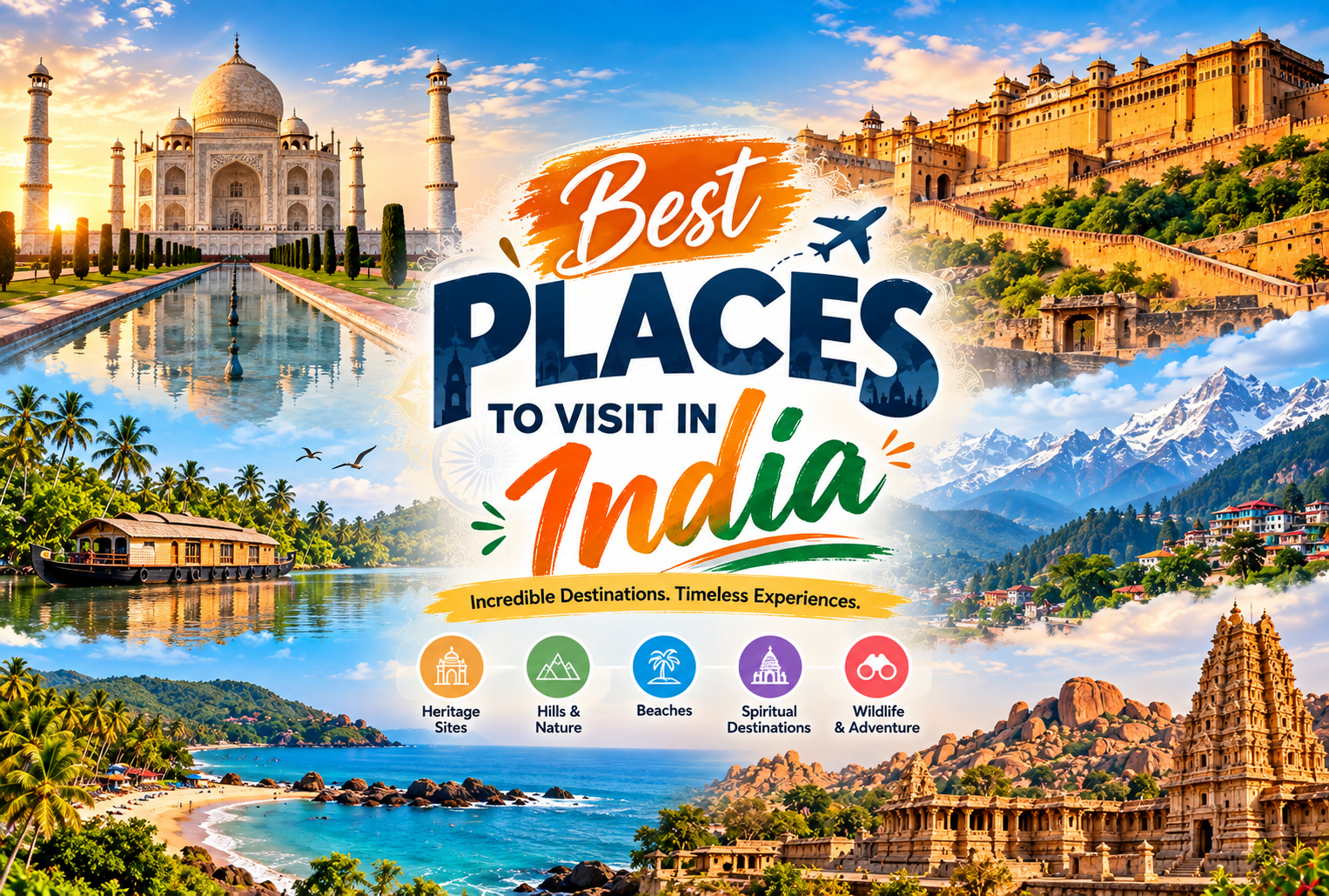
India does not fit neatly into any one itinerary. Most travel guides hand you a short list of monuments and call it a country. That is not how India works. From the Himalayan passes of Ladakh to the backwaters of Kerala, the range of landscapes, cultures, and experiences here is unlike anywhere else on Earth.
This India Travel Guide covers 25 of the best places to visit in India — organized by category, built for every type of traveler, and grounded in what actually makes each destination worth the trip. Whether you are chasing mountain views, pristine beaches, historic cities, wildlife encounters, or deep cultural experiences, this list covers it.
Check this against your travel goals before you book anything.
Why India Rewards the Traveler Who Plans
Most people underestimate India's size. The country spans over 3.2 million square kilometers. A poorly planned trip means spending most of your time in transit instead of actually experiencing destinations.
The best time to visit most of India is October through March, when the weather is dry and manageable. Hill stations and mountain regions like Ladakh and Manali are best visited between May and September. Wildlife parks see peak activity between February and May.
Plan around your interests first. Then build your itinerary.
Mountains: Best Places to Visit in India for Scenic Escapes
Mountain travel in India is not just about scenery. These regions carry distinct cultures, languages, and ecosystems that no other part of the country replicates. If you are looking for top hill stations to visit this summer, start here.
1. Leh-Ladakh, Jammu & Kashmir
Leh-Ladakh is the destination that resets your perspective on what travel can be. Sitting at an altitude of over 3,500 meters, the landscape is all barren mountains, turquoise lakes, and ancient Buddhist monasteries carved into cliff faces.
The Pangong Tso Lake, the Nubra Valley, and the Magnetic Hill are the headline attractions. But the real draw is the sheer scale of it. Roads here connect to passes like Khardung La, one of the highest motorable passes in the world.
Best time to visit: May to September. The region is largely cut off by snow in winter.
2. Manali, Himachal Pradesh
Manali is the first Himalayan destination most Indian travelers experience, and it earns that reputation. The Solang Valley offers snow activities in winter, the Rohtang Pass gives you access to higher altitude terrain, and the Kullu Valley provides an easy base for paragliding and river rafting.
Do not limit your trip to the main market area. The Old Manali neighborhood and the village of Naggar give you a much quieter, more authentic version of Himachal life.
Best time to visit: October to June for snow; July to September for trekking.
3. Darjeeling, West Bengal
Darjeeling gives you the Himalayas on a completely different scale — rolling tea gardens instead of barren passes, and a toy train instead of a highway. The Darjeeling Himalayan Railway is a UNESCO World Heritage Site and one of the most scenic rail journeys in Asia.
The Tiger Hill sunrise over Kanchenjunga is the kind of view that sticks with you. The tea estates here are some of the most recognized in the world.
Best time to visit: March to May, October to November.
4. Shimla, Himachal Pradesh
Shimla was the summer capital of British India, and the colonial-era architecture along The Ridge and Mall Road still carries that history in full. It is approachable, well-connected, and an easy entry point for travelers new to hill station travel in India.
For travelers with more time, the villages around Shimla — including Chail and Fagu — are quieter and equally rewarding.
Best time to visit: March to June, December to February for snow.
5. Munnar, Kerala
Munnar sits at 1,600 meters in the Western Ghats and looks nothing like what most people expect from Kerala. The landscape is defined by rolling tea estates, mist-covered hills, and cool temperatures that rarely climb above 25°C.
The Eravikulam National Park nearby protects the endangered Nilgiri Tahr, a mountain goat found nowhere else in the world. When the Neelakurinji flowers bloom — once every 12 years — Munnar turns completely purple.
Best time to visit: September to March.
Beaches: Best Places to Visit in India for Coastal Travel
India has over 7,500 kilometers of coastline. Not all of it is equally accessible or equally worth your time. These four deliver the most distinct experiences.
6. Goa
Goa is India's most recognized coastal destination, and the divide between north and south Goa is real. North Goa — beaches like Baga, Calangute, and Candolim — carries most of the nightlife and tourist infrastructure. South Goa — Palolem, Agonda, and Cabo de Rama — offers quieter stretches, cleaner water, and fewer crowds.
Beyond the beaches, Portuguese colonial architecture in Panjim's Fontainhas quarter and the Basilica of Bom Jesus in Old Goa are worth a full day each.
Best time to visit: November to February.
7. Andaman Islands
Port Blair is the entry point, but it is Havelock Island (now officially Swaraj Dweep) that most travelers come for. Radhanagar Beach on Havelock consistently ranks among the best beaches in Asia — clear turquoise water, white sand, and almost no commercial development immediately on the shore.
Neil Island (Shaheed Dweep) is smaller, quieter, and ideal for travelers who want to escape the Havelock crowds. Scuba diving and snorkeling around the coral reefs here are among the best in India.
Best time to visit: October to May.
8. Varkala and Kovalam, Kerala
Kerala's beaches operate differently from Goa. Varkala sits atop dramatic red laterite cliffs overlooking the Arabian Sea — the Papanasam Beach below the cliffs is considered sacred and draws both pilgrims and travelers. The cliff-top restaurants and guesthouses make it a natural base.
Kovalam, just south of Thiruvananthapuram, is more developed but well-organized. The Lighthouse Beach and Hawa Beach are easy to navigate, and the town has strong Ayurveda treatment infrastructure for travelers looking to extend their stay.
Best time to visit: September to March.
9. Pondicherry
Pondicherry (officially Puducherry) is not a typical beach destination. The French Quarter — with its tree-lined boulevards, colonial villas, and mustard-yellow government buildings — is the main draw. The beaches here are modest by national standards, but the town itself is unlike anywhere else in India.
The Sri Aurobindo Ashram and the nearby planned township of Auroville attract travelers interested in meditation, yoga, and intentional living. The French-Tamil food culture produces some genuinely outstanding restaurants.
Best time to visit: October to March.
Historic Cities: Famous Places in India With Deep Cultural Roots
These cities are not just tourist places in India — they are living archives. Each one requires at least two to three days to approach properly.
10. Delhi
Delhi is not one city — it is several cities layered on top of each other across 5,000 years. Old Delhi around the Red Fort, Jama Masjid, and Chandni Chowk carries the dense, chaotic energy of the Mughal era. New Delhi, designed by Edwin Lutyens, is wide boulevards and colonial government architecture.
Three UNESCO World Heritage Sites sit within city limits: Humayun's Tomb, the Qutub Complex with its 72.5-meter minaret, and the Red Fort. Do not miss the Lotus Temple, the Akshardham Complex, or the street food corridor of Paranthe Wali Gali in Old Delhi.
Best time to visit: October to March.
11. Agra
Agra exists for the Taj Mahal, and no amount of preparation fully braces you for the first view of it. Built by Mughal Emperor Shah Jahan in memory of his wife Mumtaz Mahal, the white marble mausoleum is a UNESCO World Heritage Site and one of the most visited monuments in the world.
Stay overnight. Seeing the Taj at sunrise versus midday is a completely different experience. While in Agra, the Agra Fort and the abandoned Fatehpur Sikri complex — a ghost city 40 kilometers away — are both full-day visits in their own right.
Best time to visit: October to March. Avoid the peak summer heat.
12. Jaipur, Rajasthan
The "Pink City" earns its nickname. The old city walls and most of its historic buildings were painted terracotta pink in 1876 to welcome the Prince of Wales, and the tradition has held. Jaipur is one corner of India's Golden Triangle (Delhi, Agra, Jaipur) and one of the most photographed cities in Asia.
The Amber Fort is the primary attraction — a sprawling hilltop complex that takes half a day to cover properly. The Hawa Mahal (Palace of Winds), City Palace, and Jantar Mantar (a UNESCO-listed astronomical observatory) round out the must-visit list. The bazaars around Johari Bazaar are the best in Rajasthan for jewelry, textiles, and blue pottery.
Best time to visit: October to March.
13. Varanasi, Uttar Pradesh
Varanasi (also called Benares or Kashi) is one of the oldest continuously inhabited cities in the world — estimates put its history at over 3,000 years. It sits on the western bank of the Ganges and operates as Hinduism's most sacred city.
The Ganga Aarti ceremony at Dashashwamedh Ghat each evening is one of the most arresting cultural rituals in India. Sarnath, just 10 kilometers away, is where the Buddha gave his first sermon — one of the most important sites in Buddhism globally. Varanasi is not comfortable travel. It is dense, loud, and emotionally intense. But nothing else prepares you for the depth of what India carries.
Best time to visit: October to March.
14. Amritsar, Punjab
Amritsar holds the Golden Temple (Sri Harmandir Sahib) — the holiest shrine in Sikhism and one of the most visited places of worship in the world. The temple complex serves a free meal to over 100,000 people daily through the langar system, regardless of religion or background.
The Wagah Border ceremony at sunset — where Indian and Pakistani soldiers conduct a formal retreat with military precision and crowd theatrics — draws thousands of visitors daily. The food culture in Amritsar, built around kulchas, dal makhani, and lassi, is worth the trip on its own.
Best time to visit: October to March.
15. Mumbai, Maharashtra
Mumbai is India's financial and entertainment capital, and the city functions at a pace that is genuinely unlike anywhere else in the country. The Gateway of India, Elephanta Caves (UNESCO World Heritage Site), Marine Drive, and the Chhatrapati Shivaji Maharaj Terminus (another UNESCO site) are the landmark visits.
The Dharavi neighborhood offers guided tours that challenge every assumption about urban poverty and entrepreneurship. Bandra and Colaba have the best restaurant and cafe culture. The Dhobi Ghat open-air laundry is one of the most photographed industrial sites in Asia.
Best time to visit: November to February.
16. Mysuru (Mysore), Karnataka
Mysuru holds the Mysore Palace — one of the most ornate royal palaces in India and the most visited monument in the country after the Taj Mahal. Illuminated with 97,000 light bulbs during the annual Dasara festival, it is a spectacle that draws visitors from across the world.
The Chamundi Hills, the Brindavan Gardens at KRS Dam, and the Devaraja Market are all within easy reach. Mysuru is also a recognized center for traditional yoga, with several long-established institutes operating here.
Best time to visit: October to February; October for the Dasara festival.
Wildlife Parks: India Vacation Destinations for Nature Travelers
India holds over 500 wildlife sanctuaries and national parks. These four are the most significant — each offering a distinct ecosystem and a different set of species.
17. Ranthambore National Park, Rajasthan
Ranthambore is India's most accessible tiger reserve and one of the most photographed wildlife destinations on the continent. Bengal tigers here are known for daytime activity — more visible here than in most other reserves. The park's ruined Ranthambore Fort and scattered medieval temples create a backdrop that looks pulled from a Kipling story.
Safari slots fill fast. Book at least two to three months in advance for peak season visits.
Best time to visit: February to May.
18. Jim Corbett National Park, Uttarakhand
Jim Corbett is India's oldest national park, established in 1936. It protects a significant population of Bengal tigers alongside leopards, Asian elephants, and over 600 bird species. The Ramganga River runs through the park, creating riverine habitat that supports crocodiles and gharials.
Corbett is divided into five zones — Dhikala, Bijrani, Jhirna, Durga Devi, and Sitabani — each with a different character. Dhikala is the most wildlife-dense but requires an overnight stay inside the park.
Best time to visit: November to June.
19. Kaziranga National Park, Assam
Kaziranga protects the largest population of Indian one-horned rhinoceroses in the world — over 2,600 rhinos in a single park. It is also home to wild water buffaloes, swamp deer, tigers, and one of the highest densities of tigers in any national park globally. The park holds UNESCO World Heritage Site status.
Elephant safaris here offer access to terrain that jeeps cannot reach. Flooding during monsoon forces wildlife onto higher ground, creating unusual viewing conditions — some operators run boat safaris during the flood season.
Best time to visit: November to April.
20. Bandhavgarh National Park, Madhya Pradesh
Bandhavgarh has the highest concentration of Bengal tigers relative to its size of any park in India. Once a hunting ground for local Maharajas, the park now operates as one of the most serious conservation areas in the country. Leopards, sloth bears, nilgai, and sambar deer are also common sightings.
The ancient Bandhavgarh Fort sits at the center of the park, accessible only on elephant safari. The ruins here date back over 2,000 years.
Best time to visit: October to June.
Cultural Destinations: Top Places to Visit in India Beyond the Tourist Trail
These destinations carry histories and artistic legacies that most itineraries skip entirely.
21. Udaipur, Rajasthan
Udaipur is built around Lake Pichola and the Aravalli Hills, and it earns every comparison to a fairytale city. The City Palace complex stretches along the eastern bank of the lake and took nearly 400 years to complete — each ruler added to it. The Lake Palace, now a heritage hotel sitting in the middle of the lake, is one of the most photographed buildings in Rajasthan.
Udaipur's Bagore Ki Haveli hosts daily folk dance performances, and the craft bazaars around Hathi Pol specialize in miniature paintings, silver jewelry, and handwoven textiles.
Best time to visit: September to March.
22. Hampi, Karnataka
Hampi is the ruined capital of the Vijayanagara Empire, which was once one of the largest cities in the world. Spread across a surreal landscape of giant granite boulders and rice paddies, the site holds over 1,600 surviving remains of temples, royal enclosures, elephant stables, and market streets — all now a UNESCO World Heritage Site.
The Virupaksha Temple has been in continuous use since the 7th century. The Vittala Temple complex, with its famous stone chariot and musical pillars, is the architectural highlight of the site.
Best time to visit: October to February.
23. Pushkar, Rajasthan
Pushkar is built around one of India's holiest lakes — one of the few places in the country with a Brahma Temple. The town is small, walkable, and runs at a noticeably slower pace than the rest of Rajasthan.
Every November, Pushkar hosts the Pushkar Camel Fair — one of the largest camel fairs in the world, attracting traders, performers, tourists, and livestock from across the region. Outside of fair season, the ghats, rooftop cafes, and surrounding desert landscape make it an excellent base for two to three days.
Best time to visit: October to March; November for the Pushkar Fair.
24. Kolkata, West Bengal
Kolkata (formerly Calcutta) is India's cultural and intellectual capital in a way that no other city replicates. The Victoria Memorial, the Howrah Bridge, Park Street, and the Indian Museum (the oldest and largest in Asia) are the headline attractions.
The city's real depth is in its Durga Puja festival in October — a five-day celebration that turns every neighborhood into an outdoor art installation. The food culture here, built around mishti doi, kathi rolls, mustard-based fish curries, and rosogolla, is the most distinct in India.
Best time to visit: October to March; October for Durga Puja.
25. Khajuraho, Madhya Pradesh
Khajuraho holds a group of medieval Hindu and Jain temples built between 950 and 1050 AD, now a UNESCO World Heritage Site. The temples are known globally for their erotic stone carvings, but the majority of the sculpture work actually depicts everyday life, celestial beings, and mythological scenes.
Only about 20 of the original 85 temples survive, and the preservation quality is high. The annual Khajuraho Dance Festival in February and March draws classical dancers from across India for open-air performances against the temple backdrop.
Best time to visit: October to March.
How to Plan Your India Trip: Practical Tips
India rewards travelers who do their homework. A few practical points before you book:
- Visa: Most international travelers require an Indian e-Visa, which can be processed online in 3 to 5 business days. Check your country's eligibility before planning.
- Domestic travel: Indian Railways is the most cost-effective way to cover long distances. Book through the IRCTC website at least 60 to 90 days in advance for popular routes. Budget airlines like IndiGo and Air India connect most major cities.
- Health: Consult a travel medicine doctor before departure. Vaccinations for typhoid, hepatitis A, and malaria prophylaxis are standard recommendations for most India itineraries.
- Currency: India is still largely a cash economy in smaller towns and rural areas. Carry rupees. ATMs in major cities are reliable, but remote areas may not have consistent access.
- Accommodation: Options range from budget guesthouses under ₹500 per night to heritage palace hotels charging several hundred dollars. Book in advance during peak season (October to February) and around major festivals.
For travelers planning international travel from India, a comprehensive Budget International Travel Guide for Indians can help optimize costs across flights, accommodation, and visas. If you are researching visa free countries for Indian travelers, that research is worth doing before you finalize any international add-ons to your trip.
Final Word
India is not a destination you finish. Every region has its own language, cuisine, geography, and cultural logic. The 25 places listed here represent the clearest entry points into that range — but the country has at least 25 more that could have made this list.
Pick the category that matches what you are looking for. Build your itinerary around two or three regions maximum for a two-week trip. And leave room for the unplanned detours — in India, those are usually the best parts.
Start planning your next trip today with our full India Vacation Destinations guide, and explore more resources across our Best Tourist Places To Visit In India series for destination-specific itineraries, packing lists, and travel cost breakdowns.