
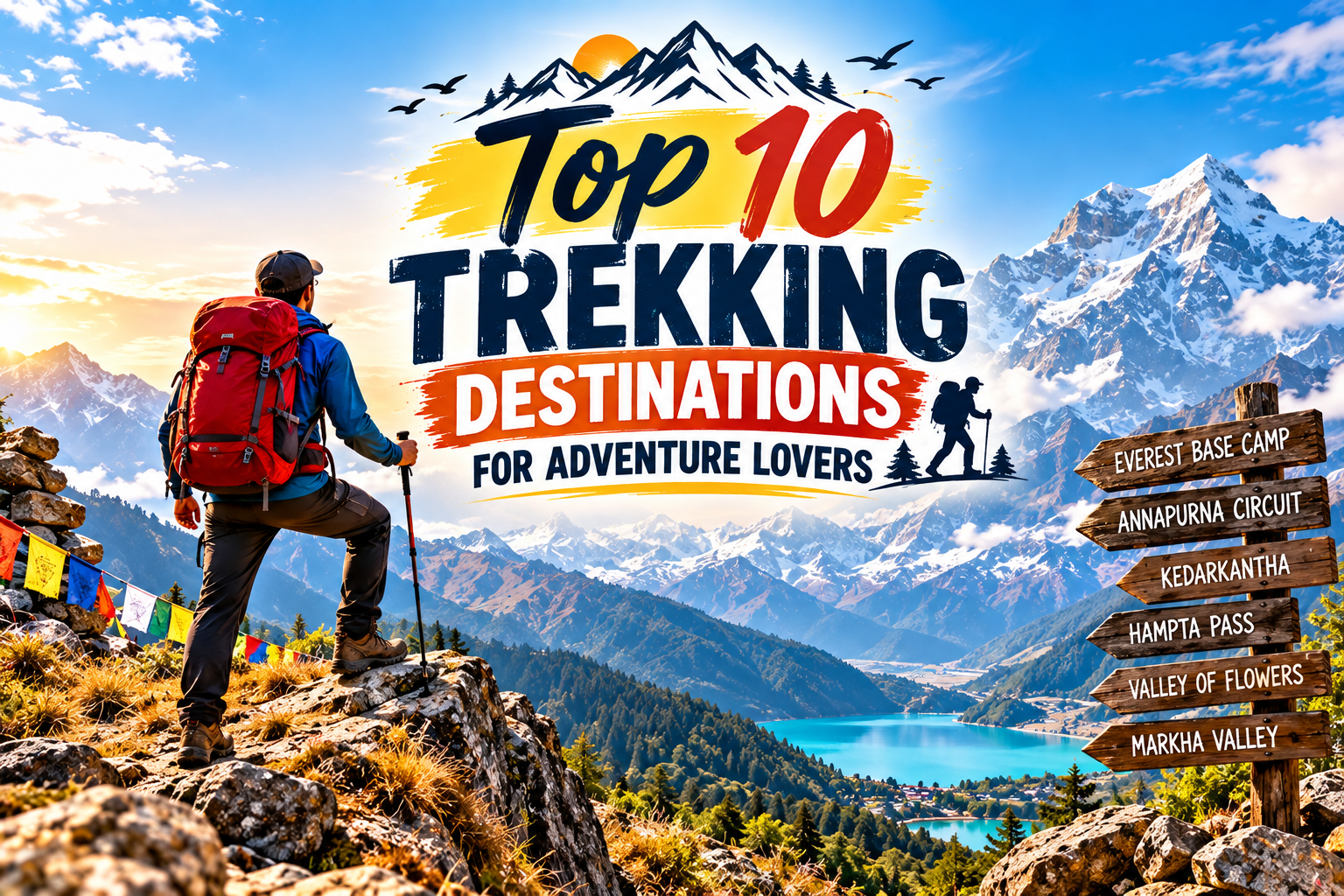
The top 10 trekking destinations span six continents and range from Nepal's Everest Base Camp (5,364m) to Patagonia's Torres del Paine. Whether you're a first-time hiker or a seasoned mountaineer, these trails offer the world's most breathtaking landscapes, rich cultural encounters, and unforgettable adventure trekking experiences.
Some trails test your lungs at altitude. Others challenge your legs across hundreds of miles of rugged terrain. A few do both. But the best trekking places around the world share one thing: they change you. The views stay with you long after the aches fade.
This trekking travel guide covers the top 10 trekking destinations across the globe—what makes each one special, how long each takes, and who each trail is best suited for. Use it to plan your next mountain trekking adventure, or simply to start dreaming.
1. What Makes the Everest Base Camp Trek the World's Most Famous Hike?
Location: Khumbu Region, Nepal
Distance: ~130 km (81 miles) round trip
Duration: 12–14 days
Max Altitude: 5,364m (17,598 ft)
Few hiking destinations carry the same weight as Everest Base Camp. Starting from the mountain airstrip at Lukla, trekkers wind through Sherpa villages, suspension bridges draped in prayer flags, and ancient monasteries before arriving at the foot of the world's highest peak. The trail demands patience—acclimatization days are essential—but the payoff is unmatched. Best visited between March–May and September–November.
Best for: Trekkers seeking a high-altitude mountain trekking challenge with deep cultural immersion.
2. Why Is the Annapurna Circuit One of the Best Trekking Destinations in Nepal?
Location: Annapurna Region, Nepal
Distance: 130–230 km (80–143 miles)
Duration: 12–22 days
Max Altitude: 5,416m (17,769 ft) at Thorong La Pass
The Annapurna Circuit loops around the entire Annapurna massif, crossing diverse ecosystems from subtropical forests to high-altitude desert. Cresting the Thorong La Pass at 5,416m is the trek's defining moment—a grueling ascent rewarded with panoramic views across the Himalayas. Unlike Everest Base Camp, the Circuit also takes you through remote Mustang villages that feel untouched by modern life.
Best for: Adventure trekking enthusiasts who want variety and cultural depth alongside altitude.
3. Is the Inca Trail to Machu Picchu Worth the Hype?
Location: Andes Mountains, Peru
Distance: 42 km (26 miles)
Duration: 4 days
Max Altitude: 4,215m (13,828 ft)
Short answer: yes. The Inca Trail is one of the most iconic trekking places on Earth for good reason. This UNESCO World Heritage route threads through cloud forest, alpine tundra, and Incan ruins before delivering trekkers to the Sun Gate above Machu Picchu at sunrise. The trail is permit-restricted, meaning only 500 people per day are allowed entry—book months in advance. The four-day, 42 km route is manageable for most fit hikers.
Best for: History lovers and adventure trekkers who want a manageable but deeply rewarding high-altitude experience.
4. What Is the Torres del Paine W Trek and Why Should You Do It?
Location: Patagonia, Chile
Distance: ~80 km (50 miles)
Duration: 4–5 days
The W Trek in Torres del Paine National Park is the crown jewel of South American adventure trekking. Named for the W-shaped route it traces, this trail passes the iconic granite towers of Torres del Paine, the cerulean Grey Glacier, and the jagged Cuernos peaks. Patagonia's weather is notoriously unpredictable—wind, rain, and sunshine can hit in the same hour—but that raw, elemental quality is part of the appeal.
Best for: Trekkers who want dramatic mountain scenery without extreme altitude.
5. Can Anyone Summit Kilimanjaro? What Trekkers Need to Know
Location: Tanzania, Africa
Duration: 5–9 days (depending on route)
Max Altitude: 5,895m (19,341 ft) — Uhuru Peak
Mount Kilimanjaro is Africa's highest point and the world's tallest free-standing mountain. Unlike most mountain trekking at this altitude, Kilimanjaro requires no technical climbing experience—just fitness, determination, and a good acclimatization strategy. The Rongai route is particularly popular, offering ever-changing terrain from grassy slopes to lunar-like conditions near the summit. Many 2026 departures are timed to reach the summit under a full moon.
Best for: Those wanting to summit a major peak without requiring mountaineering skills.
6. What Makes the Camino de Santiago a Unique Hiking Destination?
Location: Spain and Portugal
Distance: Varies by route (the Portuguese Camino from Porto: ~240 km)
Duration: 10–14 days (Portuguese route)
The Camino de Santiago is less about conquering altitude and more about the meditative rhythm of walking. Pilgrims have followed this ancient network of trails to the Cathedral of Santiago de Compostela for over a thousand years. The Portuguese Camino—one of the most scenic routes—follows the Atlantic coast through fishing towns and Galician farmland. Each trekker earns a Compostela certificate upon completion.
Best for: Those seeking a culturally rich, spiritually meaningful trekking experience.
7. What Is the Tour du Mont Blanc and Is It Doable for Non-Experts?
Location: France, Italy, and Switzerland
Distance: ~170 km (105 miles)
Duration: 7–11 days
The Tour du Mont Blanc circles the Mont Blanc massif—Western Europe's highest peak—across three countries. The trail passes through charming Alpine villages, wildflower meadows, and glacial valleys, with mountain huts (refuges) available for overnight stays. It's a moderately challenging route that rewards trekkers with some of the finest alpine scenery in the world.
Best for: Trekkers who want world-class European mountain trekking with comfortable accommodation options.
8. What Trekking Experience Does the Milford Track in New Zealand Offer?
Location: Fiordland, South Island, New Zealand
Distance: 53.5 km (33 miles)
Duration: 4 days
Often called the "finest walk in the world," the Milford Track in New Zealand's Fiordland National Park is a Great Walk in every sense. The trail crosses the dramatic MacKinnon Pass (1,154m), passes towering waterfalls, and ends at the stunning Milford Sound. The Department of Conservation manages the track carefully, limiting daily walker numbers to preserve its pristine condition.
Best for: Hikers looking for a structured, well-maintained trail with stunning fiord scenery.
9. Why Is Trekking the Great Wall of China a Once-in-a-Lifetime Experience?
Location: Northern China
Duration: 5–10 days (depending on section)
Walking a stretch of the Great Wall is a completely different beast from visiting it as a day tourist. Multi-day trekking routes—such as the journey from the Dragon's Head at the Bohai Sea to the rolling hills of Jinshaling—reveal crumbling watchtowers, dramatic ridgelines, and sweeping rural landscapes far from tourist crowds. The National Park Service describes the route as "the world's longest museum."
Best for: History buffs who want to combine adventure trekking with deep cultural discovery.
10. Is the Trans-Bhutan Trail One of the Most Underrated Trekking Places in the World?
Location: Bhutan, Eastern Himalayas
Distance: ~400 km (250 miles)
Duration: 35 days (full route)
Used by royal couriers, soldiers, and pilgrims for five centuries before road construction made it obsolete in the 1950s, the Trans-Bhutan Trail reopened in 2022 after extensive restoration. A local guide is required, and costs for a through-hike run around $20,000—but shorter sections near Paro start from just $375 for five days. Few trails offer this level of cultural immersion: ancient fortresses, red panda sightings, and home-cooked meals of ema datshi (chili and cheese stew) await.
Best for: Serious adventure trekkers seeking a rare, off-the-beaten-path experience with extraordinary cultural depth.
Plan Your Next Adventure: Where Do You Start?
The top 10 trekking destinations listed here span vastly different difficulty levels, climates, and cultures. The Inca Trail suits first-time altitude trekkers with 4 days and 42 km. Everest Base Camp demands 12–14 days and respect for altitude. The Trans-Bhutan Trail is a lifetime commitment.
Whatever your fitness level, there's a trail here with your name on it. Research your chosen route thoroughly, book permits early for high-demand trails like the Inca Trail and Milford Track, invest in proper gear, and—most importantly—go at your own pace.
The best trekking destinations don't just offer scenery. They offer perspective.